
Financial Institutions & Lenders
Representation in sophisticated financial disputes involving lenders, financial institutions, borrowers, counterparties and the enforcement and recovery of assets.
When a Loan Goes Wrong, Priority and Speed Decide Recovery.
Lenders and financial institutions depend on enforceable security, credible guarantees and timely action when a borrower defaults. Recovery is often contested, by borrowers, guarantors, other creditors and at times counterparties alleged to have committed fraud, and priorities can shift quickly once insolvency proceedings begin.
ME Law acts in Ontario for lenders, institutions, borrowers and counterparties in loan enforcement, receivership, priority and recovery disputes.
LOAN ENFORCEMENT
Security, guarantees and default remedies
RECEIVERSHIP
Court-supervised realization
ASSET RECOVERY
Tracing, priority and fraud

Typical Disputes Facing Lenders and Financial Institutions
Recovery and enforcement disputes in this sector commonly include:
Loan Enforcement
Enforcing loan and security agreements after default, including mortgage enforcement and realization on collateral.
Guarantees
Claims on, and defences to, personal and corporate guarantees, including disputes about scope, enforceability and notice.
Receivership
Applications to appoint a receiver and disputes about the receiver's powers, costs and conduct.
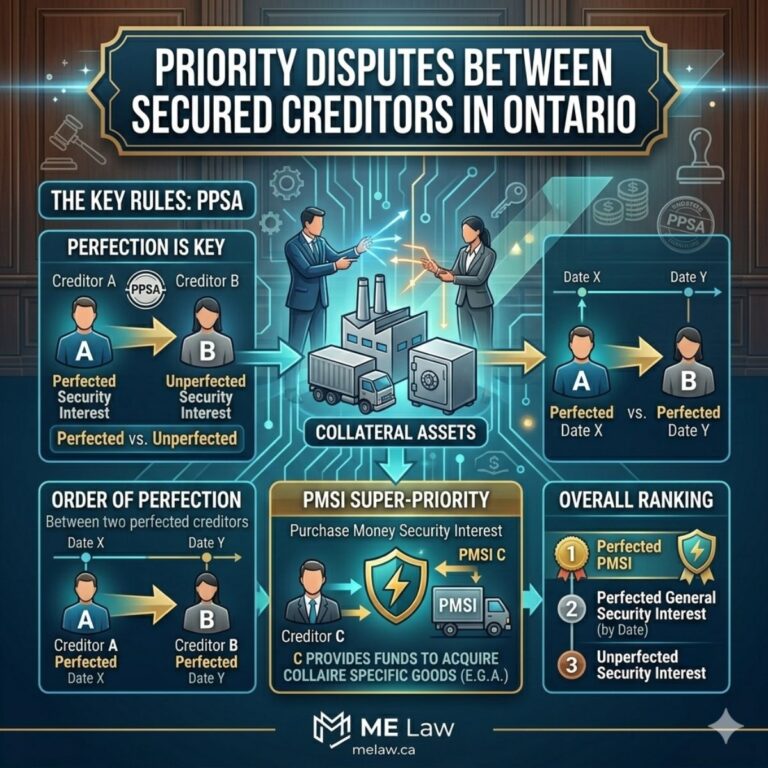
Priority Disputes
Competing claims between secured and unsecured creditors over ranking, charges and the proceeds of realization.
Counterparty Fraud
Claims arising from misrepresentation, diverted funds or fraud by borrowers, intermediaries or other counterparties.
Financial Markets Disputes
Derivatives, ISDA and structured-product disputes between institutions and their counterparties.
How ME Law Helps
Our work for lenders and institutions is built around leverage and timing: securing the strongest enforcement position, seeking court-supervised receivership where it protects value, and pursuing recovery against those responsible where funds have been diverted. We coordinate enforcement, insolvency and fraud-recovery strategy so that each step supports the next.
Receivership, Insolvency and Bankruptcy Litigation
When a business faces financial collapse or a debtor defaults, the legal…
Judgment Enforcement Lawyer
Obtaining judgment is often only the beginning of the recovery process. ME…
Fraud Recovery Lawyers
ME Law represents businesses and creditors in fraud recovery matters involving asset…
Lawyers for Lending & Recovery Disputes
Our lawyers’ published practice areas include loan enforcement, receivership proceedings, and financial and banking disputes.



Financial Institutions & Lenders FAQs
Answers to common questions about disputes in this sector.
When can a lender apply to have a receiver appointed in Ontario?
A court can appoint a receiver where it is just or convenient to do so, under section 101 of the Courts of Justice Act and, for secured creditors, section 243 of the Bankruptcy and Insolvency Act. Courts consider factors such as the terms of the security, the risk to the collateral and the debtor's conduct. See receivership and insolvency litigation.
How is a personal guarantee enforced?
Usually by suing the guarantor on the guarantee, often by motion for summary judgment where the documents are clear. Guarantors may raise defences, for example about the guarantee's terms, notice or alleged changes to the underlying loan, so enforceability depends on the wording and the facts. See enforcement.
How are priority disputes between creditors decided?
Priority is determined by the security documents, registrations (for example under the Personal Property Security Act or the land registry), statutory priorities and court-ordered charges. Insolvency proceedings can rearrange ranking, so these disputes often turn on timing and perfection. See priority disputes between creditors.
Can money lost to fraud be recovered?
Sometimes. Remedies can include freezing orders, tracing, claims in fraud, breach of trust or unjust enrichment, and recovery from third parties who received the funds. Speed matters because assets can be moved. See fraud recovery.
General information only. It is not legal advice, and the position in any matter depends on its facts and the governing law.